A guest reflection by Jeremiah Evans. Jeremiah recently completed our Level I training course in Catechesis of the Good Shepherd. I asked him to share from a man's perspective how this course impacted his life. This was his response.
Isn’t it weird how you can say a word again and again until it loses its meaning? Isn’t it sad how we can hear a passage of scripture again and again until it loses its meaning?
You don’t see that same tendency in children. As G.K. Chesterton says, the child never tires of the swing, or the story, or the game. “Again, again!” they cry with glee, and again and again it is as new to them as the first time. But then we grow up, and we say, “This again?”
I wonder if this is part of what Jesus meant when he said in Matthew 18:3, “Amen, I say to you, unless you turn and become like children, you will not enter the kingdom of heaven.” We cannot tire of listening to the Word of God, or ever assume that we understand it completely.
Training in Catechesis of the Good Shepherd is often called “Remedial Childhood,” and for me I don’t think that there’s a better example than Psalm 23. It’s probably one of the best known verses, certainly the best known Psalm. How many of us have written it, recited it, cross-stitched it, or reproduced it in some other craft as children, but how many of us think about it on a daily basis? How many of us are moved when we hear it proclaimed at Mass?
I wasn’t.
How sad it is that I can become immune to the wonder that every child seems to experience so naturally? People tell me I know things, I clearly love Jesus, shouldn’t I be dumbfounded by this?
Well, I am now. Not through knowledge, but through humility.
Psalm 23 is a very hard teaching. Not hard to grasp intellectually like how Jesus is both Human and Divine, or how the Eucharist appears as bread and wine but is actually the very Body and Blood, Soul and Divinity of Jesus. It is hard because it demands humility, which as an adult with adult responsibilities, in a culture that tells me to focus on myself and what I want, seems almost impossible to have.
There is nothing I lack? What about the new car/clothes/computer I want? What about the will power to control my temper or my appetites?
What about the four children whose names are inscribed on a block of marble?
Don’t tell me there is nothing I lack.
But maybe I just haven’t been listening. Maybe I need to say as the child does, “Again!”
What does it mean to lack nothing in the face of loss? How can I become a child again with all the responsibilities that come with being an adult, a parent, a member of my faith community?
Going through CGS training helped me to rediscover this verse, to see it in a light I hadn’t before. To sit with it, ponder it, taste it. To ask for the Father who gives so many good gifts to show me those gifts.
I’m still learning to be as a child. I’m learning to not be defined by what I have, what I know, or even what I’ve lost. I am not those things, I am a child of the Father, a sheep in the fold of the Good Shepherd.
The Father, the giver of gifts, who has given me every one of my talents, has blessed me in countless ways. He has given me so many friends, my family, my wife. The children I hold in my arms, and the children who intercede for me without ceasing.
He is my shepherd, and He has given Himself to me.
And if I have Him? There is nothing I lack.
We are happy to announce that another 90-hour Level I formation course will be offered beginning this September. All Saints is able to offer this course at a significant discount for parishioners. For more information, check out our parish website at www.dmallsaints.org/cgs-formation-courses.
Showing posts with label Catechists. Show all posts
Showing posts with label Catechists. Show all posts
Monday, June 26, 2017
Monday, May 8, 2017
Congrats to the New Catechists!
Last weekend was a bit bittersweet, as we completed a 90-hour formation course and certified 11 new catechists in our region (8 of whom are either parishioners or have already committed to serving All Saints parish!) It was an interesting journey, watching a room that is filled with a diverse crowd including a restaurateur, an information technologist, a few stay-at-home moms, a dad who just wanted to do this to be a better dad, folks who do theology for their hobby, folks who do catechesis for their jobs, and even a Computer Science professor as they worked together and came away with a renewed sense of wonder at the mystery of God and the children they will care for. I hope you will join me on congratulating them on finishing this first part of their journey, but more importantly, praying for them as they step softly into the world of serving the 3-6 year old child's spirituality.

It was also a special moment for me as I bid adieu to Ms. Elizabeth Stone, whom some of you know from her time working here when she was just 17 years old, and again for a year after graduating from college. She assisted me in this Level I CGS course, and I was so grateful to have that time with her before she moves on to her new life. This weekend, on May 13th, she will celebrate the Sacrament of Marriage and become Mrs. Elizabeth. Godspeed, dear friend! We were so blessed to have you here, even if only for a little while.
Monday, April 24, 2017
Serious Leisure and CGS
A guest reflection by parishioner and catechist, Janet Van Pelt.
Have you ever had a hobby or an activity that was so
exciting and interesting that it encompassed most of your free time and then
you wanted to continue to commit and develop yourself?
To be honest, my answer up until this past year was “No, not
really.” Who even has free time these days? What would I even do in my leisure
time? Do I even have free time to commit to an activity? When you have a busy
schedule with two young girls, a husband, a massive extended family, and
work…life gets kind of crazy. Sadly, my short-term casual leisure activities
had been going to the gym for a quick run or work out, going to the grocery
store by myself or even taking that quick 5 minute shower. Yes, I would
volunteer my time for different activities when I could but they were never
weekly commitments that directly impacted my family or really fulfilled me.
My oldest attended School of Mary Montessori last year and the
offering of Catechesis of the Good Shepherd (CGS) was one of the main reasons
why my husband and I enrolled her. I have had a lot of experience with Catholic
Religious education. I went through grades K-8th at a Catholic
school, taught Confraternity of Christian Doctrine (CCD) to kindergartners
while in high school, and I was my husband’s Rite of Initiation of Adults
(RCIA) sponsor and accompanied him to his classes while I was a graduate
student; however, none of these Catholic programs seemed to offer the amazing
gifts like my daughter at age two experienced in CGS; it was incredible!
I finally decided this year I wanted to volunteer in any
capacity with CGS at All Saints since my oldest was of age to be enrolled. To
my excitement, they were offering a Toddler Environment for volunteer
catechists and their children. This was a huge bonus since my youngest could participate, too, and I was assigned to assist with the Infants-Toddlers! I had not yet been able to take any CGS
formation courses, but this past March, I was totally blessed to participate in
the seminal Infant-Toddler Catechesis of the Good Shepherd Training course. It
was a completely enriching experience and pretty life changing to say the least!

The Infant-Toddler Training course unwrapped so many gifts
for my family but it benefited me more than I could have ever
expected. It was a beautiful experience and much needed! I took this course
anticipating being a better catechist but throughout the course I was helped to
define my pursuit as a catechist and what all that encompasses. This experience as a catechist would directly
influence my family life, but it also helped me find what I have been seeking for
myself. As a catechist, I was finally experiencing serious leisure again!

Serious Leisure
Serious leisure was a topic I researched as a graduate
student, and I had the privilege to interview Dr. Robert Stebbins who developed
this sociological theory and leisure perspective. In 2008, Stebbins continued
his 30-years-plus work on serious leisure and wrote a book entitled Serious Leisure: A Perspective of Our Time.
The definition of serious leisure on page 5 is:
The systematic pursuit of an
amateur, hobbyist, or volunteer core activity that people find so substantial,
interesting, and fulfilling, that in the typical case they launch themselves on
a (leisure) career centered on acquiring and expressing a combination of its
special skills, knowledge and experience.

There are 6 qualities associated
with serious leisure: persevere, career, personal effort, durable benefits,
identification, and unique ethos. As a catechist, I would definitely agree to
experiencing all of these.
1). Persevere- As it was my first
year in a Toddler Atrium as a CGS catechist, I was unfamiliar with the
environment and processes. There were many times in the beginning where the
Atrium was working towards normalization, but I had to push through, stick it
out, and have faith that things would get better.
2). Career- The stages in which a
person develops and achieves a practice or skill. I know after this toddler
training and being trained in other levels, I am going to be a better
catechist. It takes a lot of time and as catechists we are continuing to
develop ourselves to meet the needs of the children in our Atria by taking
formation courses and other trainings.
3). Personal effort- Taking the
knowledge I learn from trainings and applying it in the Atrium as a catechist.
4). Durable benefits- A sense of
accomplishment of a skill. As a
catechist, I have a sense of self-development and renewal after a really great
session.
5). Identification- I can now associate
myself as a catechist.
6). Unique Ethos- There is a spirit
of a community of participants with shared practices and values or beliefs. I am a part of a CGS catechist community at
All Saints, and in our diocese, and the CGS USA organization.

Serious leisure also has 7 personal rewards: personal
enrichment, self-actualization, self-expression, self-image, re-recreation, and
financial return.
1.)
Personal enrichment- Cherishing the moments in
the Atrium or with other catechists.
2.)
Self-Actualization- Developing skills,
abilities, and knowledge as a catechist in the Atrium or continuing to take
formation courses.
3.)
Self-expression- Expressing skills, abilities,
and knowledge already developed.
4.)
Self-Image- Again, identifying as a catechist.
5.)
Re-recreation- Revisiting a moment or
presentation and recreating it for each child.
6.)
Financial Return- Although catechists do not get
paid, we do receive discounts and tuition waivers for our children since we are
volunteering our time.

Serious leisure also has social rewards:
1). Social
Attraction that is associated with other fellow catechists, the parish family
or church community coming together. Hosting catechist teas or meetings and
other CGS events provides means social interaction.
2). Group accomplishment
with catechist activities or presentations.
3).
Contribution to the maintenance of carrying on CGS and developing sense of
being needed in the parish community and contributing altruistically to the
program.

“Do not conform yourselves to this age but be transformed by the renewal of your mind, that you may discern what is the will of God, what is good and pleasing and perfect.”

(Photos are from catechist formations, catechist teas, certificate ceremonies, materials-making events, retreats, in-services, and other adult formation opportunities connected with being a CGS catechist).
Monday, February 6, 2017

Wednesday, February 1, 2017
Notes on This Week's Catechist Tea
When we learned of how Sofia Cavalletti, Gianna Gobbi, and catechists who worked with them would meet in the atrium after sessions each week and drink tea while discussing how things went in the atrium that week, we got the idea to gather as best we can in our program, have some tea (or hot chocolate, or decaf coffee!), and discuss life in the atrium. We call these gatherings "Catechist Tea" and we try to have them quarterly, or monthly, or even weekly, depending on the year and availability of catechists. We had one this Tuesday after our session and were joined by catechists from all of our sessions. This was some of the fruit of our discussion:
1) Broad (and then particular) discussion on what we are noticing. Is CGS serving the children and the families? Catechists shared many beautiful stories about how things are going with interesting comments children have made, work that they have chosen/created, and how we see glimpses of a profound relationship that is developing in the children. We may not be able to "test" the children or "measure" them, because how can you really "measure" a relationship? But as one Level II catechist reflected, "The only difference I can really put my finger on is that the children are happy and excited to come in and that the don't want to leave at the end. So much so that they are actually upset when we ring the bell to invite them to restore their work. That's different from any other experience of RE that I know of..." The other catechists concurred that this is their experience as well. I added the other big difference: "It is probably just as amazing, if not more so that the catechists share that." I know that sometimes it is a struggle in the atrium... Sometimes personalities don't mesh (and come and talk to me so we can do something about it!), but by and large, the overwhelming experience in the atrium is retreat-like and positive for all involved. This is something of a minor miracle. Maybe even a major one.
One new thing this year is having "tea" (usually cider or hot chocolate are chosen over the tea) with the children who are in Level III (4th-6th graders) during extended presentations on Bible Studies. The children have loved this and feel very "adult" as they open their bibles together and discuss the scriptures.
**It was also noted how much the children, even the Level I and toddlers, LOVE the opportunities for Eucharistic adoration. The other comment was about the LINES for confession each month. This is something of a surprise to us grown-ups.**
It was also noted that 70% of the children in our program have parents who volunteer weekly or monthly (donating meals and serving the catechists!). While we don't have any solid numbers to compare this to, we feel that so much adult/parent involvement is something that continues to communicate to the children how important they and their inner life with God is to us.
2) Observations: Discussion about how and why we spend time in observation (instead of always in direct contact with the children or in discussion with other adults in the room). What sets our approach apart is that we do not primarily observe the children, but how the environment serves the children (and we adults are part of that environment). We are not primarily looking to see what the child needs "next" but to see what material is calling children to personal work, and which is not (is it because it is poorly designed? in a bad location? does the drawer stick? did I give a poor presentation that didn't draw them in? Were the consumable materials restored so there was enough for the child to finish and restore his work?) We are constantly looking at ways to improve the environment, trusting that the more prepared the environment, the better will we serve the children. The children can handle "disordered movements" from other children far more easily than they can handle disordered movements from the adults in the environment. After a period of time, when we see work cycles that are complete (get a mat for work, get work from shelf, do work--greatest concentration at the end, restore work to shelf and roll up mat, sense of fulfillment) and an atmosphere of peace and helpfulness in the atrium, even in snatches, we see that the environment is serving the children.
3) Albums and Record Keeping: Catechists were further invited to use down-time in the atrium (or train your assistants) to update the permanent record sheets that tell us which presentations a child has received. My goal for next fall is to have 100% of the children with a permanent record sheet that follows them to the next level. These are simply a tool to help catechists in a program as large as ours, but a great gift. If we do this well, we can serve the children even better. I did hear a comment though that I want to address: While we do want the children to see presentations and get the most out of each level, it is not a goal to have the children see 100% of the material in each level. If you have a child who decides to work extensively with geography, for example, and is focused on the booklets and looking up the cities in the bible, and can do the whole pin map without looking at the control, you do not need to worry that the child is being "shorted" because he did not see an expanded parable work. Trust the child. If he is deeply engaged in his work, we have seen the fruit of ours.
As to albums: I encourage each catechist to make it a goal to rewrite your albums over the long course of your work as a catechist. Your group album is not YOUR album. Even your first album that you write 100% in your own words is not really complete. It is the work of the catechist to prepare (and constantly rework) his or her album. If you have not done this (and most of us have not), you are working in the atrium without the preparation that is most essential to your work in the atrium: your own deep reflection on the doctrinal content of the presentation, the aims, and the meaningful questions that you offer to the children. Please consider making it a goal to work on at least a couple of album pages before the end of the year. I will check over them if you need me to.
I am again humbled by these fabulous catechists of our parish, and I look forward to welcoming more men and women into our ranks in the coming years. For now, though, I am looking forward to next month's tea. We are always growing, and what a blessing that we can grow together!
1) Broad (and then particular) discussion on what we are noticing. Is CGS serving the children and the families? Catechists shared many beautiful stories about how things are going with interesting comments children have made, work that they have chosen/created, and how we see glimpses of a profound relationship that is developing in the children. We may not be able to "test" the children or "measure" them, because how can you really "measure" a relationship? But as one Level II catechist reflected, "The only difference I can really put my finger on is that the children are happy and excited to come in and that the don't want to leave at the end. So much so that they are actually upset when we ring the bell to invite them to restore their work. That's different from any other experience of RE that I know of..." The other catechists concurred that this is their experience as well. I added the other big difference: "It is probably just as amazing, if not more so that the catechists share that." I know that sometimes it is a struggle in the atrium... Sometimes personalities don't mesh (and come and talk to me so we can do something about it!), but by and large, the overwhelming experience in the atrium is retreat-like and positive for all involved. This is something of a minor miracle. Maybe even a major one.
 |
| A group of children chose to "visit Jesus" before atrium began last week. |
**It was also noted how much the children, even the Level I and toddlers, LOVE the opportunities for Eucharistic adoration. The other comment was about the LINES for confession each month. This is something of a surprise to us grown-ups.**
 |
| A 6th Grader chose to copy the "History of the Jewish People" Timeline |
It was also noted that 70% of the children in our program have parents who volunteer weekly or monthly (donating meals and serving the catechists!). While we don't have any solid numbers to compare this to, we feel that so much adult/parent involvement is something that continues to communicate to the children how important they and their inner life with God is to us.
2) Observations: Discussion about how and why we spend time in observation (instead of always in direct contact with the children or in discussion with other adults in the room). What sets our approach apart is that we do not primarily observe the children, but how the environment serves the children (and we adults are part of that environment). We are not primarily looking to see what the child needs "next" but to see what material is calling children to personal work, and which is not (is it because it is poorly designed? in a bad location? does the drawer stick? did I give a poor presentation that didn't draw them in? Were the consumable materials restored so there was enough for the child to finish and restore his work?) We are constantly looking at ways to improve the environment, trusting that the more prepared the environment, the better will we serve the children. The children can handle "disordered movements" from other children far more easily than they can handle disordered movements from the adults in the environment. After a period of time, when we see work cycles that are complete (get a mat for work, get work from shelf, do work--greatest concentration at the end, restore work to shelf and roll up mat, sense of fulfillment) and an atmosphere of peace and helpfulness in the atrium, even in snatches, we see that the environment is serving the children.
3) Albums and Record Keeping: Catechists were further invited to use down-time in the atrium (or train your assistants) to update the permanent record sheets that tell us which presentations a child has received. My goal for next fall is to have 100% of the children with a permanent record sheet that follows them to the next level. These are simply a tool to help catechists in a program as large as ours, but a great gift. If we do this well, we can serve the children even better. I did hear a comment though that I want to address: While we do want the children to see presentations and get the most out of each level, it is not a goal to have the children see 100% of the material in each level. If you have a child who decides to work extensively with geography, for example, and is focused on the booklets and looking up the cities in the bible, and can do the whole pin map without looking at the control, you do not need to worry that the child is being "shorted" because he did not see an expanded parable work. Trust the child. If he is deeply engaged in his work, we have seen the fruit of ours.
 |
| A gathering of catechists in my home as we discuss "The Domestic Church" (There were 35 children in the basement that day!) |
I am again humbled by these fabulous catechists of our parish, and I look forward to welcoming more men and women into our ranks in the coming years. For now, though, I am looking forward to next month's tea. We are always growing, and what a blessing that we can grow together!
Monday, November 2, 2015
The Best Thing I Ever Did
About 11 years ago, someone invited me to take a class on how to teach preschool religion. I had an almost-preschooler and a new baby. The cost was a bit steep at $375, but everyone spoke so highly of this 8-day course, I decided to go for it. After a few days in the course, I was more than intrigued by the formation - I was hooked! That was when I realized that this was only Part ONE of the Level I course, and that the following summer would be another 8 days and another $375! But it was too late. I was already sold. Eleven years later I will still tell you it is the best thing I did for my faith, my parenting, and maybe my life!
Not everyone begins formation for Catechesis of the Good Shepherd as blindly as I did. I showed up the first day unaware that this was more like a college course than a workshop. Even if it was more educational than I forsaw, it was also far more of a spiritual investment than I expected.
Ever since that summer in 2004, I have been telling everyone I knew to give some time to be formed in CGS, and if they can manage it, to get trained in all three levels (270 hours!) In the years since I was trained, things have changed quite a bit in our area. The biggest change is that we have local trainers, and the cost and format of the trainings have been streamlined.
About 2 years ago, with much prayer and trepidation, I began the discernment process of working to become a formation leader for Level I of Catechesis of the Good Shepherd. It was about 6 weeks ago that I received my recognition as a formation leader from the National Association. I have long desired to open this opportunity to adults who are not quite ready to make the commitment to be catechists, but who have been hearing of the spiritual fruit that is coming from these incredible formation courses and want to come and see!
I am thrilled to announce that as part of our Adult Faith offerings at All Saints, we will be offering a national Level I course (serving 3-6 year old children) beginning in January for a parishioner rate of $60 for the whole course! (Out of parish participants will pay $300 for all 90 hours).
For more information about CGS, this course, or to register, check out our parish website: www.dmallsaints.org/cgs or our blog at allsaintscgs.blogspot.com. Class size is limited to the first 15 participants (and it is my secret hope that many of them will be MEN). I hope to see you on the first day, January 16th!
Not everyone begins formation for Catechesis of the Good Shepherd as blindly as I did. I showed up the first day unaware that this was more like a college course than a workshop. Even if it was more educational than I forsaw, it was also far more of a spiritual investment than I expected.
Ever since that summer in 2004, I have been telling everyone I knew to give some time to be formed in CGS, and if they can manage it, to get trained in all three levels (270 hours!) In the years since I was trained, things have changed quite a bit in our area. The biggest change is that we have local trainers, and the cost and format of the trainings have been streamlined.
About 2 years ago, with much prayer and trepidation, I began the discernment process of working to become a formation leader for Level I of Catechesis of the Good Shepherd. It was about 6 weeks ago that I received my recognition as a formation leader from the National Association. I have long desired to open this opportunity to adults who are not quite ready to make the commitment to be catechists, but who have been hearing of the spiritual fruit that is coming from these incredible formation courses and want to come and see!
I am thrilled to announce that as part of our Adult Faith offerings at All Saints, we will be offering a national Level I course (serving 3-6 year old children) beginning in January for a parishioner rate of $60 for the whole course! (Out of parish participants will pay $300 for all 90 hours).
For more information about CGS, this course, or to register, check out our parish website: www.dmallsaints.org/cgs or our blog at allsaintscgs.blogspot.com. Class size is limited to the first 15 participants (and it is my secret hope that many of them will be MEN). I hope to see you on the first day, January 16th!
Monday, March 23, 2015
Religious Education and Spiritual Orphans
I read a really thought-provoking article last week that made me reflect more deeply on what exactly a religious education program can and can't offer families. The article was critical of the Church for her "hero complex"--you know, the tendency for priests, DREs, youth ministers, Catholic school teachers and catechists to swoop in and attempt to evangelize and catechize a child who has little to no understanding of the faith,without really identifying and addressing the problem that kids are coming to them as "spiritual orphans."
If I had to make an educated guess, it is probably the fault of some well-meaning people from years ago who led a subtle or not-so-subtle campaign to tell parents: "You can't teach this! The faith is difficult and hard to understand! The Bible? What do you know about the Bible? You must send your child to religious education classes or Catholic schools so that we "professionals" can pass on the faith."
Well, something awful happened. While so many people trusted the "experts," the faith simply slipped through the cracks of the generations. We as an institutional Church have discovered that 1 hour per week (or even several hours per week) plus Sunday Mass (if we're lucky) isn't enough to pass on a living, vibrant faith to the next generation. There is a generation of parents and maybe even grandparents, who may be in the Church, but have never really had a life-changing encounter with Christ.
You see, the idea of "either/or"--where either the parents teach the Faith or they trust Father or Sister or the catechist--misses the point.
The family is the first Church, the Domestic Church. Everything the family does: from prayer, training in virtue, to modeling forgiveness and acts of mercy, prepares the child for a fuller Christian life. We as a parish education program promise to do all we can to support you in this role, but we can never replace you.
If you were one of these "spiritual orphans" growing up, and still don't have a lot of confidence in your prayer life, or in your knowledge of the teachings of Jesus and His Church, it is not too late! We are always offering opportunities for adults to go deeper and mature in their understanding and relationship to Christ. Also, as any CGS catechists will tell you, Catechesis of the Good Shepherd formation is a most excellent training to help you understand how to meet the needs and serve the spiritual potential of your little child or grandchild.
Opportunities and graces abound! Our Lord wants nothing more than for parents to become more serious in their role as primary educators of their children in the Faith. But as the old Latin saying goes: "Nemo dat quod non habet"--"You can't give it, if you don't got it!" So go and get it!
If I had to make an educated guess, it is probably the fault of some well-meaning people from years ago who led a subtle or not-so-subtle campaign to tell parents: "You can't teach this! The faith is difficult and hard to understand! The Bible? What do you know about the Bible? You must send your child to religious education classes or Catholic schools so that we "professionals" can pass on the faith."
Well, something awful happened. While so many people trusted the "experts," the faith simply slipped through the cracks of the generations. We as an institutional Church have discovered that 1 hour per week (or even several hours per week) plus Sunday Mass (if we're lucky) isn't enough to pass on a living, vibrant faith to the next generation. There is a generation of parents and maybe even grandparents, who may be in the Church, but have never really had a life-changing encounter with Christ.
You see, the idea of "either/or"--where either the parents teach the Faith or they trust Father or Sister or the catechist--misses the point.
The family is the first Church, the Domestic Church. Everything the family does: from prayer, training in virtue, to modeling forgiveness and acts of mercy, prepares the child for a fuller Christian life. We as a parish education program promise to do all we can to support you in this role, but we can never replace you.
If you were one of these "spiritual orphans" growing up, and still don't have a lot of confidence in your prayer life, or in your knowledge of the teachings of Jesus and His Church, it is not too late! We are always offering opportunities for adults to go deeper and mature in their understanding and relationship to Christ. Also, as any CGS catechists will tell you, Catechesis of the Good Shepherd formation is a most excellent training to help you understand how to meet the needs and serve the spiritual potential of your little child or grandchild.
Opportunities and graces abound! Our Lord wants nothing more than for parents to become more serious in their role as primary educators of their children in the Faith. But as the old Latin saying goes: "Nemo dat quod non habet"--"You can't give it, if you don't got it!" So go and get it!
Tuesday, March 3, 2015
Abraham's Offering
The first reading last week on the Offering of Isaac led to some very interesting conversations in our home. Our Catechesis of the Good Shepherd Level III (9-12 year old) atrium happens to have just finished our study of Abraham this year, so there was a lot of fodder for discussion.
In the atrium, we have walked (figuratively, anyway) with Abram from his home in Ur to "a land I will show you" and have seen Abraham's incredible trust and faith in the promise of this voice: to give him a land and descendants as numerous as the stars in the sky who will bless ALL nations. Abraham was already 75 years old when he received this promise.
Fast forward 25 years. Now the promise is seen with Abraham's own eyes: a SON. Abraham holds the promise in his arms. It kind of reminds me of Simon, in the Presentation in the Temple, who holds the Christ Child in his arms and says in effect, "Now you may let your servant go in peace! I've seen the promise!"
But Abraham's faith, made strong through 25 years of hope realized, is put to the test. This promise... this EVERYTHING of Abraham's... God asks him to offer as a sacrifice.
It is striking and maybe shocking to us that the same Abraham who intercedes so beautifully for the Lord not to destroy the cities of Sodom and Gomorrah would not intercede for his son! It's almost like Abraham was expecting this, and indeed, if we look at the history of the peoples surrounding him, sacrifice of the first-born son was indeed a common practice. Do you give your god the sickly and weak animal? Do you offer your leftovers to him? No. The idea that led to this practice was that to prove your love for your god, you must offer your best--your everything.
But Abraham was not like the other people of his time, and the God who revealed Himself to Abraham was not just another god among gods. He is the One, True God: the God of Life.
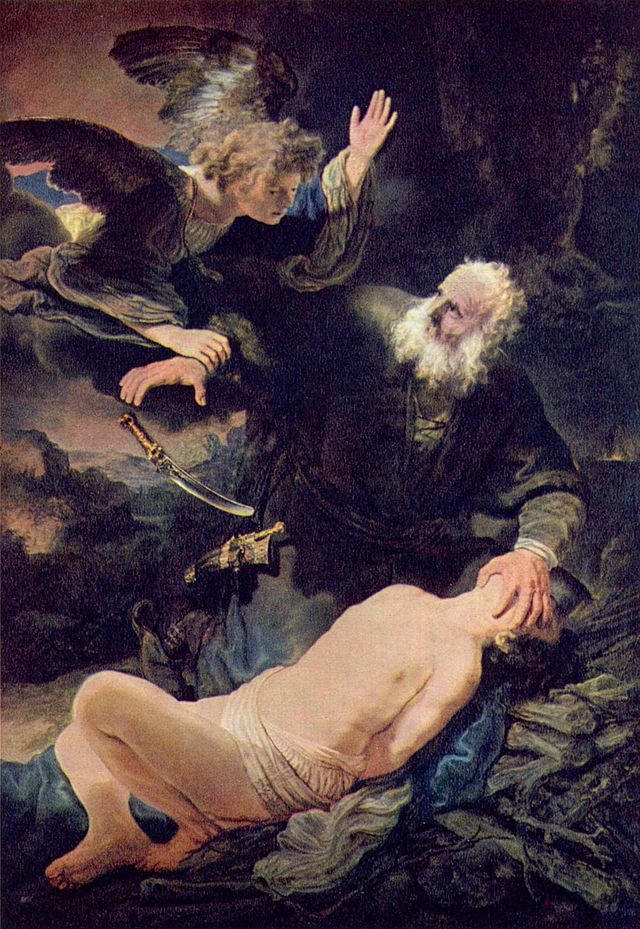 |
| Sacrifice of Isaac by Rembrandt (1635) |
In the atrium, we have walked (figuratively, anyway) with Abram from his home in Ur to "a land I will show you" and have seen Abraham's incredible trust and faith in the promise of this voice: to give him a land and descendants as numerous as the stars in the sky who will bless ALL nations. Abraham was already 75 years old when he received this promise.
Fast forward 25 years. Now the promise is seen with Abraham's own eyes: a SON. Abraham holds the promise in his arms. It kind of reminds me of Simon, in the Presentation in the Temple, who holds the Christ Child in his arms and says in effect, "Now you may let your servant go in peace! I've seen the promise!"
But Abraham's faith, made strong through 25 years of hope realized, is put to the test. This promise... this EVERYTHING of Abraham's... God asks him to offer as a sacrifice.
It is striking and maybe shocking to us that the same Abraham who intercedes so beautifully for the Lord not to destroy the cities of Sodom and Gomorrah would not intercede for his son! It's almost like Abraham was expecting this, and indeed, if we look at the history of the peoples surrounding him, sacrifice of the first-born son was indeed a common practice. Do you give your god the sickly and weak animal? Do you offer your leftovers to him? No. The idea that led to this practice was that to prove your love for your god, you must offer your best--your everything.
But Abraham was not like the other people of his time, and the God who revealed Himself to Abraham was not just another god among gods. He is the One, True God: the God of Life.
Abraham's offering was total obedience and trust to this God of Life. He trusted in a God who would not lie. Isaac was the son promised, the beginning of an explosion of blessings through Abraham's descendants. The author of Hebrews saw in Abraham's offering a New Testament faith:
"By faith Abraham, when put to the test, offered up Isaac, and he who had received the promises was ready to offer his only son, of whom it was said, 'Through Isaac descendants shall bear your name.' He reasoned that God was able to raise even from the dead, and he received Isaac back as a symbol." Hebrews 11:17-19 Abraham obeyed God because he trusted in His promise.
As incredible as Father Abraham's faith is in this story, I hope you don't miss how God totally flips the sacrifice on its head. For so much of human history, we see human beings wishing to prove their love and devotion to their god or gods. They gave their best for the love of their god. Yet, the One, True God says, "Do not do the least thing to him... I know now how devoted you are..." and provides his own Lamb for the holocaust. In offering His only begotten Son, the Father in Heaven reveals the unfathomable reality that He offers His Best for love of us.
"For God so loved the world that he gave his only Son, so that everyone who believes in him might not perish but might have eternal life." John 3:16
Wednesday, July 2, 2014
Catechist Prayer Group
Dear CGS Catechists and Assistants,
I have so much I want to share with you after a blessed week in Georgia for the Level I Formation Leader's Training Course. Among the beautiful gifts I received last week, one of them is a new and clear perspective about prayer and the work of the catechist.
As you know, when we prepare materials for the atrium, it is a further opportunity to reflect on the beauty of the presentations we will offer to the children.
It was a surprise to me that one of the seasoned formation leaders did not let her participants even BEGIN writing an album page without first working directly with the material for a sustained period of time. God makes himself present in the tangible--He uses stuff to teach us about Himself! The catechist, through his or her proclamation AND the material she prepares, makes present the mysteries for the children and for him/herself, even if in a hidden way. We must take time with the physical material in order to understand what is hidden!
I invite you to consider joining us for our prayer/material-making sessions from 2-5 or 6-9pm on Wednesdays this month. It will be a time of fellowship, creativity, and, yes, prayer. If you cannot join us, don't worry! We'll have plenty to do that we will invite people to take home for personal or family prayer time.
Hope you are having a blessed summer!
~Mandie
Monday, June 30, 2014

Monday, January 21, 2013
Stumbled Upon a Goldmine

A guest reflection by parishioner Melissa Hill
“What are they doing?”
This was one of the first thoughts I had when I was led into the atrium, the Catechesis of the Good Shepherd classroom, for the first time. The room was unlike anything I had seen before, and I have to admit that this style of Religious Education seemed a bit odd.
Having just registered at All Saints, I was determined to get my kids involved. So I decided to stay around and watch what they were doing. By the end of the session, I was very interested in what was happening there. I thought I needed to learn more about it, and honestly, it would have been hard for me to leave my children in an environment I didn’t understand. When invited to become an assistant in the room, I agreed without hesitation.
Within only a few weeks, I knew I had stumbled upon a goldmine. This "weird" form of education was producing a profound result with the children. Not only did they know terminology I didn’t know as an adult, they had a reverence for the liturgy and scripture that I hadn’t seen before.
Later that year, I enthusiastically entered into the formation course for Catechesis of the Good Shepherd, but I had no idea the impact my formation would have on my personal relationship with God and Church. I thought this would be a class on how to be a catechist in this new style of classroom. Sure, that was part of my journey, but equally as significant was my own formation, my own experience.
During the extensive training sessions, I became like the child myself and learned about liturgy, scripture and relationship in a way I never had. I came out of the educational experience with a certificate of completion and ready to lead an atrium. I also came out with a new excitement for Catholicism and a readiness to make changes in my own life. I am convinced that the Catechesis of the Good Shepherd program has made me a better mother and wife, and has been the catalyst for so many other growth opportunities for me.
I am so grateful that instead of turning around and going the other way, I was willing to go inside that strange looking classroom and find out for myself what was going on in there!
May God bless your families and your week! ~Mandie DeVries, Director of Religious Education

Subscribe to:
Posts (Atom)