Welcome to our archived site of the work of CGS at All Saints Parish up to April of 2018!
Showing posts with label Level III. Show all posts

Monday, February 5, 2018

How Many Times do I have to Tell You?

I love the Abraham year.

In Level III (4th-6th grade) CGS we have five typologies that we work through on a three year cycle: Creation and Sin in year one, Flood and Abraham in year two, and Moses in year three. I really do enjoy each one, but I think Abraham is my favorite.

Typology studies are as much a gift to us catechists as they are to the children. This is my third time through Abraham since beginning Level III in CGS, and I learn something new every time. To start, we spend several weeks reading the account in the Old Testament. In the case of Abraham, we read several passages from Genesis and use a few card/description packets to help us understand what Abraham's time and life was like. One child was inspired to make a card packet of his own "Ankeny life" in comparison with Abraham's nomadic life.

Our weeks and weeks of reading and studying and waiting for the son of the promise, Isaac, to be born were nothing compared to Abraham's 25 year wait. The children's jubilation at Isaac's birth is quickly turned to sorrow and pain as we immediately follow his birth story with the Genesis 22 account of that fateful day when Abraham was "put to the test." It began with that same voice that Abraham had heard so many years before.

Answering the First Time

"Abraham!" God called.
"Ready!" replied Abraham.

The exchange that follows is so difficult to understand in a world that has been formed by 3800 years of monotheism. What? God is asking Abraham to offer his "only one, whom you love" and offer him on a "height I will show you"? What is going on here?

It is helpful that in our atrium we had lived with the children the previous 4 weeks in the world of Abraham. Abraham didn't know the future. He was the only person in the whole world who believed in the One, True God. He was surrounded by polytheists who had allegiances all over the place or by henotheists who were singularly dedicated to their own god, but didn't believe that their god was the only one. It was not unusual for religious people at that time to prove their love and devotion to their particular god by laying down the most important thing, or even the most important person, in their life.

When God calls Abraham, Abraham's response makes us think that Abraham was expecting this request. The Lord calls his name only once. "Ready!" he replied.
So often, looking back on this event after nearly 4 millennia, we can only respond with horror, wondering how or why God could do this. But, as we point out to the children in the atrium, the really shocking thing about this story is not so much that Abraham, a man of his own time, would be "ready" to do this, but that God stopped him. Many years later, through the prophet Jeremiah, the Lord tells his people that human sacrifice is something that the One, True God never "considered, or said, or commanded" (Jer 19:5, cf. Jer 32:35).

"Abraham! Abraham!" 

Abraham was ready to obey the Lord at the first call, but I find it very interesting that it did take calling his name two times for God to convince Abraham to stop. The Lord was training up the very first monotheist. Abraham, our father in faith, had to have a pure heart in serving the One, True God. Not even the promise, not even the son, could be more central to his life than God. Abraham was so ready to make the sacrifice of obedience that God had to tell him twice to lay down the knife. The Lord asks us for everything, but He doesn't always take it.

In the coming weeks, we will continue to study Abraham, but this time in light of the revelation of Jesus Christ in the New Testament (typology). How many times can we read and study His Word and still let it escape our notice that our God loves us so much that He turned history and the whole idea of sacrifice on its head? 

As Abraham tells his son on the way to Mt. Moriah, "The Lord Himself will provide the lamb for the sacrifice" (Gen 22:19). And so it happened.

"For God so loved the world that he gave his only Son so that everyone who believes in him might not perish, but might have eternal life" (John 3:16).

Thursday, December 7, 2017

Prepare Ye

"The people who walked in darkness have seen a great Light" Isaiah 9:2.


This week, many of our Level I children as young as three years old heard these words spoken eight centuries before Jesus Christ was born. God is preparing His people for a gift, we tell them, and through the prophets, God tells us for what and whom, and even where, we should look.

A light. A star. A ruler. A son. Born of a Virgin. Emmanuel: God with us. Bethlehem. A child with authority. Wonder Counselor. God-Hero. Father-Forever. Price of Peace.

All of these things the prophets foretold. As we prepare these children to celebrate the mystery of Christmas, all of these signs point to that child who lays there in a feed box for animals. It's an incredible paradox: King of the world. Foretold for centuries. Heralded by angels. Lying in a manger?

It's all there, just like the prophets said, but it isn't quite as we might expect it. Good thing God pointed the way for all those years, or we might have missed it!

As the children grow, we offer further reflections on the Messiah "who is to come" from the prophets. In Level II (for 1st-3rd grades) and Level III (4th-6th) we hear about the incredible peace that will flood the earth. The wolf will lay down with the lamb. The young lion and the calf shall browse with the young child to lead them. No harm or ruin on all my holy mountain. The earth shall be filled with knowledge of the Lord as water covers the sea. There will be no mourning or wailing. Death will be destroyed forever.

Is this what we see on Christmas? Even the most stubborn optimist would have to admit it is not. Jesus is the Savior, and He did come to establish His kingdom. Yet we wait for the day when "everything is subjected to him" and "God will be all in all" 1 Cor 15:28.

With the children, we reflect deeply on the prophets' words because they have relevance for us today. The prophets had a call, a vocation, to listen deeply to the word of God--to encounter Him in their own hearts. From the depths of this relationship of listening, the prophet speaks God's message. It is not just to the people of their time, but of our time as well. Their words not only prepare us to recognize and accept Jesus Christ who is born on Christmas morning as the Messiah foretold, but to look and prepare carefully for the Parousia: that time in which God will be all in all.

Wednesday, April 26, 2017

Red is for Pentecost

In the atrium, our celebrations mirror the liturgical year as much as possible. We are simply living and enjoying the life and rhythm of the Church year with the children.

The exceptions are when the "school year" has ended before the greatest celebrations have taken place. So even though we still have several weeks left to enjoy and you grow from the Feast of Easter, we celebrate Pentecost this week with the children in our Level 1, 2, and 3 atria, as this is already our last day in the atrium. It's such a beautiful reflection on the "Birthday of the Church" and the gifts of the Holy Spirit that came not only to those who are waiting in the upper room, but also to each of us.


Thursday, April 20, 2017

Liturgy of Light

Exult! Let them exult! The hosts of heaven!


An excerpt of the Exsultet (sung by one of the children) during this morning's Liturgy of Light in the atrium. The 4th-6th grade children prepare this special celebration of Easter (modeled after the opening rites in the Easter Vigil) for the younger children. There may have been happy tears on the part of some adults in the room!

Tuesday, April 18, 2017

On Us and on the Whole World

This Sunday we celebrate the (relatively) new feast of Divine Mercy. As you may know, the Divine Mercy Chaplet and this devotion to Jesus under the title of Divine Mercy has its roots in Poland.

St. Faustina Kowalska, who died just before the invasion of the Nazis in 1939, received this image of Jesus in prayer. He asked her to have it painted and to tell the world of His burning desire to pour His Mercy out on the whole world.


Divine Mercy

And Poland would need this gift in the decades to come.

Recently I was meditating on the Healing of the Paralytic with some 4th-6th graders in our CGS Level 3 atrium. In that instance, Jesus asked the question to the incredulous bystanders: "Which is easier, to say, ‘Your sins are forgiven,’ or to say, ‘Rise and walk’?" Luke 5:23.

One of the girls thought it was definitely easier to say, "Your sins are forgiven." As we thought about it, we realized that any of us could say whatever we wanted to the paralyzed man, but it wouldn't heal him. We could tell him to rise and walk all day, but he'd still lay there, paralyzed. It seemed that Jesus was trying to make a connection between the man's paralysis and his sin. He was stuck and could not move without God's action.

"But I can forgive people," the girl insisted. "I may not be able to heal their body, but I can stop being angry. I can forgive."
We thought about this together for several minutes. Why is it easy for me to forgive? When is it easy for me to forgive? We talked about Pope St. John Paul II forgiving his would-be assassin who shot him point blank several times. Was that easy? Maybe it would be easier for me to say powerless words like "Rise and walk" before I could say the words "I forgive you" and mean it. Sometimes it is we who are paralyzed because we are unable to forgive.

As I reflect on the wisdom of God in His gift of the Divine Mercy image, chaplet, and devotion, I see the Divine Physician at work: healing Poland, which could have been paralyzed in hate and anger, but instead brought forth some of the greatest saints of modern times. He can do the same in our lives, if we let His Mercy flow into us and heal us, but more than that, if we let it flow through us to others.

"Have Mercy on us, and on the whole world."

Friday, February 10, 2017

Work Is Love Made Visible


It's funny how we model the faith in the littlest things. The children come into the atrium and it is all prepared for them. They leave it beautiful when it is time to go. They take care of the environment and each other. Parents have told me that when they use our language at home, they find a magical power to the words: "It is time to restore our work." It isn't magic, though. It is tapping into the dignity and desire of the child to live in harmony with those around them. It gives purpose to their work and their life.

"Work is Love made visible." Kahlil Gibran

A photo posted by Sweet Oak Gallery (@sweetoakgallery) on

Monday, December 5, 2016

When God Will Be All in All

To celebrate the beginning of Advent, our Level III (4th-6th grade) children studied the Prophecy of the Shoot of Jesse and the Peaceable Kingdom last week. You would be amazed at the quality of theologians we have in this parish.

This was the passage we focused on:

"The wolf shall dwell with the lamb, and the leopard shall lie down with the kid, and the calf and the lion and the fatling together, and a little child shall lead them. 

The cow and the bear shall feed; their young shall lie down together; and the lion shall eat straw like the ox. The sucking child shall play over the hole of the asp, and the weaned child shall put his hand on the adder's den. 

They shall not hurt or destroy in all my holy mountain; for the earth shall be full of the knowledge of the LORD as the waters cover the sea. 

In that day the root of Jesse shall stand as an ensign to the peoples; him shall the nations seek, and his dwellings shall be glorious." Isaiah 11:6-10 RSV

They knew that Isaiah was speaking to the people of Israel in a time of darkness. Their "glory days" seemed to be in the past (the Kingdom of Israel was split into North and South). The immediate future wasn't looking so great for them either (Babylonian exile). But here in Isaiah it seems that the prophet is trying to teach the people to listen to God and to wait in HOPE for something.

"It sounds like the the time when God will be all in all," one of the 4th grade girls offered. "Of course, Isaiah is talking about when the Messiah comes, but he's really talking about the Parousia," submitted a 6th grader in a different session.

Spending time in the atrium with the children of our parish, I am growing in my faith and perspective each year. Advent is a time of year when we listen to the prophets who prepare us for "a great light" and "a child [who] will be born to us," but as I listen carefully with these children, I can't help but realize that Advent is not primarily a celebration of Jesus' birthday. For us, it is a reminder of the hope which His Birth gives for the Parousia. (We say it Pair-uh-SEE-uh).

The time is coming when there will be no more war, no more hunger, no more wailing or pain, no more tears, and no more death. Parousia: when God will be all in all and His Kingdom will have no end.

"So," I asked the children at the end of one atrium session's reflection, "as we spend time in Advent preparing, what should we be preparing for?"

"Parousia," a child responded, as they all nodded their heads.

"And how do we do that?" I wondered.

"Well," (and I am not kidding you, a child actually said this), "we do what we can to make the world like Isaiah said: we feed the hungry, we make ourselves more like God wants us to be, so we're ready."

Let us follow the shining example of these wise children and do the same. One day, God WILL be All in All. Let us make Him so in our hearts today!

Monday, November 14, 2016

The Spirit of St. Nick

*Spoiler alert!*

Last weekend in our final day of Level I formation for Good Shepherd, a super-charged, emotional, and sensitive topic came up during break. No, it wasn't politics. It was Santa Claus.

During one of my Level III sessions the week before, the topic also came up, but not in a way I knew how to handle. As the children were studying the two creation stories in Genesis 1 and 2, some of them were really grasping to try and understand how God could have existed before there was anywhere to exist. The conversation was fascinating, but one child piped in that it was easy to understand because God is just like Santa Claus.

*Cue Awkward Pause*

I let the child's comment go without comment, because I don't want to tread on ground that is truly parent territory, but I have to say that I was troubled for the next week about this topic that has been a struggle for me as a parent and catechist for years.

What's the struggle? That expect our children to believe us when we tell them about God, but that we rarely question our culture's modern-day obsession (which began with a Coca-cola ad, by the way) with telling kids about a man with flying reindeer, who flies about the whole earth in one night to bring presents to the "good kids."

Is God Just Santa for Grownups?

Sometimes it happens that our kids can't tell the difference between the "stories" we tell them and the truth. For example, catechist at training this weekend was sharing how her son's college roommate belittles her son's faith because he thinks it's all made up to make us feel better. "God's just a grownup's Santa Claus," this young man told her son. "He's just something you believe in to make you be good and feel less depressed about the troubles of life." Now that this young man was grown up he doesn't believe in "invisible things" anymore: God included.

Another catechist from Bolivia shared that this is not a struggle in her culture because Santa isn't really a part of their Christmas traditions at all. It is baby Jesus who brings the presents (and the wise men, too--on January 6th).

So What's a Parent to Do?

Everyone of us encounters this culture in a different way, but after our discussion last weekend, a few of the catechists asked if I would write up our family's traditions in an article as food for thought as families are preparing for the start of Advent. So here goes...

We tell our kids the truth--the whole truth. When we talk about Santa, we talk about a Catholic bishop named Nicholas who lived over a thousand years ago in modern-day Turkey. After his parents died, Nicholas used his inherited fortune to help those in his town who were in great need. Inspired by the gifts that God showered over him, he never wanted recognition, so he gave his gifts anonymously.

His life was given to Christ, and his work to care for those in need was so inspiring that the Church recognized him as a canonized saint! Just like all saints, St. Nicholas continues to care for us and intercede for us and our needs. He inspires so many people to give without a desire to be thanked. Sometimes we'll even receive gifts like St. Nicholas gave in the stockings of those poor girls who were to be sold into slavery if their father could not pay off his debts. We can say that the spirit of Santa, of St. Nicholas, is still thriving today.

Our children set out their shoes on December 6th (St. Nicholas' feast day) and receive golden coins (made of chocolate!) and a silver dollar. On Christmas, they'll find presents addressed to them with no name (some of these are from us, some are from other people who did not want to be thanked). We say: "It must have been St. Nicholas. Remember, he didn't want you to thank him. He wants you to thank Jesus." Sometimes the girls will make gifts for each other or other people signed "From St. Nicholas."

When you think about this way, Santa (or St. Nicholas) IS like God. He is generous, loving, and cares for others without thinking of himself, just as we are all called imitate our Lord in our love for our neighbor!

Tuesday, November 8, 2016

On Catholic Guilt

"Ms. Mandie? Is tonight Reconciliation Night?"

I was walking down the hall several years ago just before our Wednesday night session began when a third grade boy named Alex asked if it was the night, once a month, that Father Harris made himself available for children who choose to go to confession.

I responded that it was indeed, and Alex gave me the first of many surprising responses that we have seen since starting Catechesis of the Good Shepherd at our parish for preparation for Eucharist and Reconciliation:

"YES!" he cheered, as he pumped his fist.


I remember how I responded to the news that we were going to confession at CCD classes back in the day. Sweaty palms? Yes. Fist pump? No.

Over the past several years, it is this common and most striking response to the Sacrament of Forgiveness that has made catechists and parents alike comment that something different indeed is going on in the hearts of these children that have been placed in our care.

Catholic guilt doesn't seem to exist for them. They seem to fly to the Sacrament of Reconciliation each month with little fear or trepidation at all. Often the lines are so long that the priest (and sometimes two priests) can't get to all of the penitents in line.


Last week I found this drawing that Adam, a fourth grade boy in our program, made during his personal work time in the atrium. I almost looked past the significance, it was so stunningly simple. Though it had been a year and a half since he'd shared in the True Vine (John 15) bible study while preparing for First Communion and First Reconciliation, this little moral theologian pondered so deeply on the parable of the True Vine that he could articulate his own motivation to keep sin out of his life... and it wasn't because of so-called Catholic Guilt.

"If your [sic] bad, you clog the goodness." 
He realized that he is a branch on that True Vine, and the goodness (grace) flows from God (the Vine) to us (the branches). When we sin, it blocks that goodness. So don't sin! It has nothing to do with being a bad person or feeling great shame. It's about letting the LIFE of GOD flow into you!


The innocent and joyful witness of these children should inspire all of us to get rid of those "sap blocks" in our lives. Let us make confession, do penance, amend our lives, and for goodness' sake, let the grace flow!

Wednesday, March 9, 2016

Pirates and Saints

You never know where the work of a Level III child might take you. In this case, it was into the land of movie-making! These boys took their saint research to a whole new level. Even though I'm the director of our program here, I joked that I was a little nervous with all of the noise that my fellow workers in the vineyard might come and take my catechist card. My assistant and I were commenting as they (loudly) rehearsed that these boys were not likely to forget the story of St. Rose any time soon. I don't think I will either!


Monday, March 7, 2016

What would You Choose?

Sometimes a topic really jumps out at the children and the catechists will see a flurry of new and intense work. This last week in Level III was like that. We are about 6 weeks into a Moses study, and in the last couple of weeks, we've seen 3-dimensional representations of the comparison between Egyptian and Hebrew life after the Exodus, lots and lots of interviewing with interesting questions, and some of the kids even got together "after hours" to work on their project. I promised I would print this here.

Hebrew Times
by Madeleine D, Lydia S, Peyton L

We interviewed several people (Jamie C., Bethany D., Mary T., Genny L.) about Hebrew Times and what they would do if they were in place of a Hebrew slave. Most people wanted to follow God, but admitted they would complain they were travelling for forty years with nothing to eat except manna (which is translated to mean “whatch-a-ma-call-it”) and birds [quail].

When Question #2 asked: If you were a Hebrew slave who had just been freed, would you grumble and complain? Mary T. answered, “Probably not at the beginning, but if I were wandering in the desert for forty years, yes.”

We were also curious of what people would think of Moses. Jamie C. answered, “I would think he’s crazy,” and Bethany D. said, ”At the beginning I’d like him, but in the middle not really.”

So what about you? Would you rather have a large spacious many-roomed house with servants and worship many gods (which are hunks of rock) or live in a cramped tent have a hard life and worship the one true god (not a hunk of rock)? Which would you choose? It’s up to you to find out.

Egyptian                         Hebrew
Good house                    Cramped tent
Fertile land                     Desert land
Servants                         No servants
Worship many Gods     Worship one true God

Chose Egyptians         Chose Hebrew
Read Exodus 7-10        Read Exodus 12-15

Friday, April 3, 2015

The Very Best Way

"Mommy?"

My very sad 7 year old sat down next to me as we returned home after Holy Thursday Mass. "Wasn't there some other way that Jesus could have saved us?  He was God.  Couldn't there have been another way?"

Another Way?

I had seen this little girl's tears at the end of Mass as the Eucharist was taken in slow procession from the Church and as the women reverently stripped the altar and removed the candles and left our tabernacle open and empty for all to see.  We were living that moment when Jesus had been taken from us, and it didn't sit well with little Leah (or me, either, to be honest).

Many worshipers had remained several moments in silence before quietly exiting or making their own sorrowful procession to the Altar of Repose that seemed to represent for us the imprisonment our Lord underwent before his death.  Our family had sat before this altar before we headed home, and I remembered how Leah's sweet little tears flowed quietly.

"Wasn't there another way?" she begged.

"Oh darling," I responded, too quickly for the words to have been my own. "He is God.  There may have been lots of ways to open the gates of Heaven, but He didn't just come to offer us salvation... He wanted us to receive it.  He chose the Cross to make us feel His love, and to draw out our love for Him.  He is God, Peanut.  So I think of all the possible ways, we can trust that He chose the very best way."

His Blood be on Us and on our Children

I'm reminded of the scripture verse from Romans 5:8: "God proves His love for us, in that while we were still sinners, Christ died for us."  To put this another way, He died for us while we were still enemies.


The crowds infamously responded to Pilate after he washed his hands "of this righteous man's blood" by saying, "His blood be on us and on our children" Matthew 27:25.  Their vitriol and hate in that moment was flung into His face and His response still shocks us...


"Yes," His love responded. "So be it."

As death was wrought and his heart was pierced, His blood did flow out and continues to flow even now over us and our children. Not as guilt or condemnation, but as an ocean of mercy that washes away all stain of sin and enmity.


You Can't Make Someone Love You

But why all this labor to win over our hearts to Him?

Jesus' parable of the prodigal son (Luke 15:11-32), the story of that privileged one who wished death on his father to prematurely claim his inheritance, and found himself in dire poverty and misery, bears an explanation.

After reflecting on this parable a few weeks ago, I asked the children in the Catechesis of the Good Shepherd atrium, "The father must have heard about the famine. He must have been so worried for his son. Why didn't the father just go and get his son and bring him back?"

A 10 year old boy answered simply, "Because he didn't want a slave. He wanted his son. You can't make someone love you."

So the father watched and waited for the day that his son would come to his senses and remember the goodness of the father that he treated so poorly.  He waited for his son to love him. Yet that prodigal had no idea how deep his father's love was until his return - when this pitiful and contrite penitent begged enough forgiveness to be considered a slave and was instead overwhelmed with mercy and received again as a son.


The Very Best Way

It is the greatest mystery of love that God would choose to die at our hands so that we may know that "truly this is the Son of God." Oh that we would have the grace to suffer so well at the hands of our enemies so as to make them our friends!  It is the path that our Savior has blazed for us, and we ought to follow. He is God after all, and has shown us not only the way, but the very best way.

Tuesday, March 3, 2015

Abraham's Offering

The first reading last week on the Offering of Isaac led to some very interesting conversations in our home.  Our Catechesis of the Good Shepherd Level III (9-12 year old) atrium happens to have just finished our study of Abraham this year, so there was a lot of fodder for discussion.
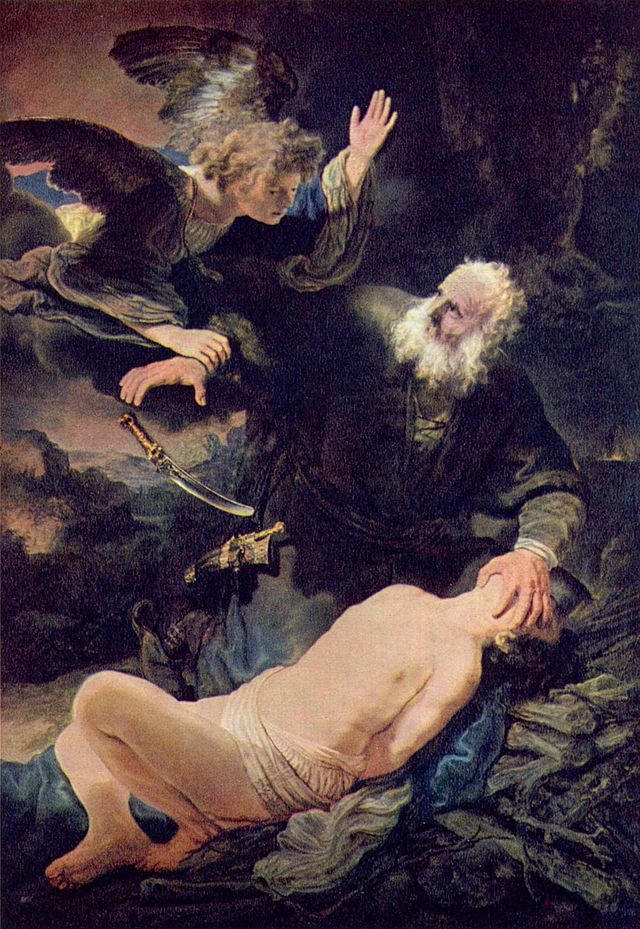
Sacrifice of Isaac by Rembrandt (1635)

In the atrium, we have walked (figuratively, anyway) with Abram from his home in Ur to "a land I will show you" and have seen Abraham's incredible trust and faith in the promise of this voice: to give him a land and descendants as numerous as the stars in the sky who will bless ALL nations.  Abraham was already 75 years old when he received this promise.

Fast forward 25 years.  Now the promise is seen with Abraham's own eyes: a SON.  Abraham holds the promise in his arms.  It kind of reminds me of Simon, in the Presentation in the Temple, who holds the Christ Child in his arms and says in effect, "Now you may let your servant go in peace! I've seen the promise!"

But Abraham's faith, made strong through 25 years of hope realized, is put to the test. 
This promise... this EVERYTHING of Abraham's... God asks him to offer as a sacrifice.  

It is striking and maybe shocking to us that the same Abraham who intercedes so beautifully for the Lord not to destroy the cities of Sodom and Gomorrah would not intercede for his son! It's almost like Abraham was expecting this, and indeed, if we look at the history of the peoples surrounding him, sacrifice of the first-born son was indeed a common practice.  Do you give your god the sickly and weak animal? Do you offer your leftovers to him? No.  The idea that led to this practice was that to prove your love for your god, you must offer your best--your everything.

But Abraham was not like the other people of his time, and the God who revealed Himself to Abraham was not just another god among gods.  He is the One, True God: the God of Life. 

Abraham's offering was total obedience and trust to this God of Life.  He trusted in a God who would not lie.  Isaac was the son promised, the beginning of an explosion of blessings through Abraham's descendants.  The author of Hebrews saw in Abraham's offering a New Testament faith: 

"By faith Abraham, when put to the test, offered up Isaac, and he who had received the promises was ready to offer his only son, of whom it was said, 'Through Isaac descendants shall bear your name.' He reasoned that God was able to raise even from the deadand he received Isaac back as a symbol." Hebrews 11:17-19  Abraham obeyed God because he trusted in His promise.


As incredible as Father Abraham's faith is in this story, I hope you don't miss how God totally flips the sacrifice on its head.  For so much of human history, we see human beings wishing to prove their love and devotion to their god or gods.  They gave their best for the love of their god.  Yet, the One, True God says, "Do not do the least thing to him... I know now how devoted you are..." and provides his own Lamb for the holocaust.  In offering His only begotten Son,  the Father in Heaven reveals the unfathomable reality that He offers His Best for love of us.

"For God so loved the world that he gave his only Son, so that everyone who believes in him might not perish but might have eternal life." John 3:16

Monday, January 13, 2014

My friend, Abraham

Just a anecdote to share this week.  One of our catechists was chatting with a parent about how things were going in the atrium with her child.  The parent shared something that happened at home that made her more intrigued as to what is going on in her child's classroom.  She said that it can be hard to get her children to share what they are learning or doing in the atrium, but they seem to enjoy going so she figured it was a good thing for them.

Then one day the family was sitting together and watching a show on The History Channel about the Bible.  She was shocked when her children began to share all that they knew about Abraham (which was far more than she knew!)  "They talked about him as though they knew him!"

It's been 2 years since we had our Abraham study with our Level III kids, and it warms the heart of any catechist to hear that what you taught has sunk in somehow.  Even more powerful was the witness that this parent gave to the intimacy that her children felt with this ancient Biblical figure.

The approach to studying the scriptures with the children, diving into the background (like how a Bedouin nomad lived and worshiped) and breaking open the typology that relates to Christ is found throughout all three years of Level III. It'll be another year until we visit Abraham again with a new group of Level III kids, but I look forward to the opportunity to introduce to them their father in faith, and hopefully a new friend.

Monday, October 21, 2013

Communal Prayer in the Atrium

Prayer changes as the children grow and move through the levels of Catechesis of the Good Shepherd.  Here's a little overview of ways we experience prayer in the atrium.

All Levels: Nearly every presentation in the atrium has an element of prayer.  Either we are solemnly reading scripture, or isolating a part of the mass, or proclaiming some truth of the Faith, but it is always a call to think more deeply, to respond with joy, and with that joy and pondering to be drawn further into relationship with God.  I wanted this post to be a picture of what "group prayer" looks like in the different levels.

Level I: In the first level the group prayer is led by the catechist. Since the children are largely pre-readers, the prayer will usually consist of reading a prayer card that was chosen (like "Hail Mary" or "Glory to God") and reflecting on those words in silence for a few moments.  The candle is always lit, and the children always marvel as we talk about Jesus as the Light!  These children also pray for their families, friends, pets, neighbors, and they also say thank you to God a LOT.  They also love to sing simple songs at prayer.

Level II (1st-3rd grades or 6-9 years): Prayer becomes more child-led in this Level.  A few examples of prayer from the past two weeks that were pretty amazing:  Two girls, a first grader and a third grader, were using a template to prepare prayer and they were trying to choose a scripture.  They began to walk around the atrium and found the Kingdom of God parables.  The older girl took the lead and they made a booklet with ALL of these parables.  They even drew pictures.  It was beautiful!  The other example was of a boy who loves to make timelines for his prayer. He made a timeline of Jesus' life.  The catechist tried to get him to limit his "props" from around the atrium to four or so, but the young 3rd grader complained, "But I want to inspire people!"  He ended up pulling the shell from the baptism work over for the moment Jesus was baptized, and he chose the scripture from the Flight into Egypt for his reading.  The final moment on the timeline was (of course) the Leaven.  He asked the other children what the meaning of the Leaven was, and after they shared their ideas, he told them that it was like heaven because it rises so big and so fast, and that is the Parousia--what we're waiting for!  It was a profound reflection and synthesis for all who shared in this prayer.

Level III (4th-6th grades or 9-12 years): Prayer here can either be much simpler than the Level II kids, or can be much more involved, depending on the time these big kids have to put into it.  A few examples from the last couple of weeks:  In one atrium, there are three girls who love to sing. Their scripture readings were chosen around the songs they wished to sing.  And they sang in parts.  And the other children in the atrium joined in.  It was like a choir broke out in the atrium. Beautiful!  Another group was of younger children, and they broke up their scripture reading into a choral reading piece, with each having their own part, and sometimes reading all together.  The very first day of Level III, a few older children decided that they had to read from the Creation story in Genesis because it tied in so well with the works they had done that day. They read the whole first chapter, and though this can be a long reading, the other children were perfectly attentive and reflective. This age child will also bring in intentions to prayer and some of the intentions these bigger kids bring can be hard and heavy.  They also like silence.  For several years we would have silent moments in the atrium and the children would all comment on how LOUD the clocks were. We just built three new atria and I had an excuse to buy new clocks for every room. Digital clocks. I can't wait to make silence with them!


Thursday, October 10, 2013

Proclaiming the Kingdom of God

At the beginning of the year in Level III there is a strong focus on the Kingdom of God: the History (from Creation, to Redemption, to Parousia), the Gifts (from the beginning of Creation that were prepared for humans, to the gift of other people, to the great gift of Jesus especially in the Eucharist), and the Plan that existed in the mind of God from all eternity: to unite all people and things in a universal (cosmic) communion of love!

Sometimes the children flow right along with the presentations, and sometimes it takes a little while for them to get back in the swing of thinking about these great mysteries.  When some young boys were working with the "History of the Gifts" material, we came upon the question: 

"Of all the gifts you have received, which is the greatest?"

For one of these boys it was very difficult to choose.  Finally it came down to a toss up between YouTube and Play Station 3.  A second boy tipped the scales when he said definitely Play Station 3.  The third boy who was younger than the other two was still writing the card that reflected on the gift of other people and was writing names of those with whom he had a special relationship.  So we posed the question to that young man.  "Of all the gifts you have received, which is the greatest?"

He turned from his work and said firmly, "Uh, Life?! Come on guys, get with the program!"

The other two boys then realized that YouTube and PS3 wouldn't mean much to them if it weren't for the gift of life, so they quickly changed their answers.  I love how the younger boy was able to proclaim this truth and help his friends become even more aware and grateful for just how greatly God has gifted them. I didn't have to say a word.


Tuesday, March 26, 2013

Moses and the History of the Jewish People

In Level III this semester, our studies have taken us deep into the book of Exodus.  Studying that people whom God chose to be His own, we have become very familiar with the history of Israel.  From their enslavement in Egypt, to God's response in the call of Moses, and up through the Gift of the Law and their entry into the Promised Land.

These last few and upcoming weeks are the capstone and pinnacle of our studies.  If you have read this blog before, you might remember that we do 5 typology studies in CGS Level III.  Typology is just a fancy word for seeing "types" or "ties" between Old and New Testament events, as they both point to a future reality that we call  "Parousia"--what we adults might call the end of time, but which the children call that time "when God will be All in All." 1 Corinthians 15:28.

Moses is one of these typologies.  After meditating (discussing and thinking hard) about the connections between crossing the Red Sea and Baptism, between Moses and Jesus, and even manna and the Eucharist, our study turns to the present.

One of the sad realities of the past 100 years, and really the past 2000 years, is that the Jewish people have sometimes not been accepted in the countries to which they have spread (diaspora). The children (especially our American children) really have a hard time understanding the reality of something like the Holocaust, or as the Jewish people call it, the Shoah, because they can't imagine a world where one "people" considers itself so superior to another that it can treat them worse than animals or insects.  Hopefully this will be true for their whole lives.

Our last reflection on the History of the Jewish people (for now!) is that the Jewish people are still waiting.  They wait for the promises which the Lord has made to them that He will send a Messiah. When that Messiah comes:


"He shall judge the poor with justice, and decide aright for the land's afflicted... Then the wolf shall be a guest of the lamb, and the leopard shall lie down with the kid; The calf and the young lion shall browse together, with a little child to guide them.
The cow and the bear shall be neighbors, together their young shall rest; the lion shall eat hay like the ox. The baby shall play by the cobra's den, and the child lay his hand on the adder's lair.
There shall be no harm or ruin on all my holy mountain; for the earth shall be filled with knowledge of the LORD, as water covers the sea." Isaiah 11: 4a, 6-10

While we believe that Jesus was and is that Messiah, we also wait for that time when all is brought to perfect fulfillment.  We have so much in common with our elder brother, the Jews, as we await that time when "God will be All in All."

God Bless,
Mandie DeVries
Level III catechist and Director of Religious Education

Monday, January 21, 2013

Stumbled Upon a Goldmine


A guest reflection by parishioner Melissa Hill

“What are they doing?”

This was one of the first thoughts I had when I was led into the atrium, the Catechesis of the Good Shepherd classroom, for the first time. The room was unlike anything I had seen before, and I have to admit that this style of Religious Education seemed a bit odd.

Having just registered at All Saints, I was determined to get my kids involved. So I decided to stay around and watch what they were doing. By the end of the session, I was very interested in what was happening there. I thought I needed to learn more about it, and honestly, it would have been hard for me to leave my children in an environment I didn’t understand. When invited to become an assistant in the room, I agreed without hesitation.

Within only a few weeks, I knew I had stumbled upon a goldmine. This "weird" form of education was producing a profound result with the children. Not only did they know terminology I didn’t know as an adult, they had a reverence for the liturgy and scripture that I hadn’t seen before.

Later that year, I enthusiastically entered into the formation course for Catechesis of the Good Shepherd, but I had no idea the impact my formation would have on my personal relationship with God and Church. I thought this would be a class on how to be a catechist in this new style of classroom. Sure, that was part of my journey, but equally as significant was my own formation, my own experience.

During the extensive training sessions, I became like the child myself and learned about liturgy, scripture and relationship in a way I never had. I came out of the educational experience with a certificate of completion and ready to lead an atrium. I also came out with a new excitement for Catholicism and a readiness to make changes in my own life. I am convinced that the Catechesis of the Good Shepherd program has made me a better mother and wife, and has been the catalyst for so many other growth opportunities for me.

I am so grateful that instead of turning around and going the other way, I was willing to go inside that strange looking classroom and find out for myself what was going on in there!

May God bless your families and your week! ~Mandie DeVries, Director of Religious Education

Monday, April 23, 2012

The Memorial

I had a guest in my atrium this past weekend, and I always wonder what an atrium session will be like when a guest is there.  As my husband tells me, it's kind of like an electron: you can't look at it without changing it.

Anyway, the children were doing their work: mostly working on the Rubrics of the Mass work and copying their own missals.  And I began the presentation of The Memorial for three of them at a time.

Now the first thing they always say when they see a familiar work is: "I've seen this one."  So when they see the Cenacle (which is the Last Supper material) all set up with the altar and candles and bread and wine and crucifix, they want to be sure this isn't a repeat.  "I promise," said I, "this work grows with you."

The premise of The Memorial is that we recognize Jesus' presence on earth 2000 years ago was a singular event.  Being so close to our Lord was a blessing that was unfathomable, and his disciples and others living at that time got to experience it.  But does this mean that we were born too late??

The work that flowed from the Cenacle was on a long orange mat (orange is consistently the color of the Liturgy of the Eucharist in CGS) and on it the children and I worked to piece together the story.  Beginning with the Last Supper, it is apparent that Jesus wanted to be with All People of All Times.  This is why he said, "This is My Body" and "This is My Blood." And why he said, "Do this in Memory of me."

The children then see the words of the consecration placed on the card speaking of that Passover meal, as well as the bread and wine (the clay paten and chalice) moving from the Cenacle work to sit beside those words on the mat below.

The following events of Jesus' life are highlighted. His Death, His Resurrection, and the Descent of the Holy Spirit.

Then we continue with a new card speaking of the Apostles repeating those words of Jesus: "This is My Body, which will be given up for you." and "This is My Blood, which will be shed for you and for many." And Jesus is again present to them.  When I asked the children how it was that Jesus was present again, one group immediately said "In the Bread and the Wine!"  While the other had to think for a moment.  Both however, were convinced of the Real Presence.  They then moved the Bread and the Wine  down from the Passover... further down the mat to this time of the Apostles.

The work continues on two more cards, one that speaks of the bishops and one of the priests.  We begin to see that the closeness, the intimate presence of the Lord is not something that only happened 2000 years ago, but it continues up to today!

Then one child saw the final card and grabbed it: "Oh, it's my favorite! The time when God will be all in all!"  She was referring to the drawing of Jesus returning in glory, with the cross that is over the whole earth.  The final point of the presentation was that this Memorial would continue to up until the time that it is fulfilled: at the Parousia!

The children were very peaceful and even sang the beautiful song that goes so well with this presentation: "We Remember."  One of them immediately grabbed the booklet that goes with the work and went to copy it.  Another found the card from the Rubrics of the Mass material called "The Memorial" and proceeded to compare and contrast that prayer with the one found in the folder.

I never know if what I see is what others see, so I asked my guest what she thought of her day in the atrium. She asked about getting her own children signed up.  I suppose that's a good sign.

In the love of the Good Shepherd,
Mandie DeVries, CGS Catechist and DRE


Tuesday, March 27, 2012

This Holy Week! CGS-Inspired Prayer Presentation for Teens and Adults

Many adults in the parish have asked if there is an "adult version" of CGS. It seems adults are drawn to the materials and intriguing presentations of the Catechesis of the Good Shepherd.

To that end, we are offering a unique Holy Week experience this year. As we celebrate the "birthday" of the Liturgy of the Eucharist on Holy Thursday, it seemed appropriate to offer a prayer presentation on Holy Wednesday called:

The Holy Mass:
The Origin of the Eucharist & The Origin of the Liturgy of the Word

These two presentations (one from Level II, and the second from Level III) will be presented live and projected on a big screen. These presentations follow the roots of the mass all the way to the time of Jesus, and even further back in time.

The "direct aim" of nearly every presentation we do in CGS is this: to lead the child to fuller participation in the mass. I believe these presentations can do this for teens and adults as well. I know they have changed forever my own experience. I hope you will join us: April 4, 2012 @ 7pm in the church! (When we finish up, the Life Teen kids will go back to their regular class!)

God Bless,

Mandie DeVries, CGS Catechist and DRE