Welcome to our archived site of the work of CGS at All Saints Parish up to April of 2018!

Saturday, April 25, 2015

Dandelions for Mother

Ahhhh, dandelion season.

It's that lovely time of year when our children spend more and more time running around outside, and more often than not, I have a little vase of fresh yellow "flowers" from my littlest ones that is constantly being refreshed.

My kiddos know that I love flowers, and even their little dandelions bring me joy because they remind me of their innocent little faces that were full of love upon handing me their gifts.

Next week (May 4th), at the 8:30 mass, our parish will have its annual May Crowning.  The women and girls of the parish will bring forward flowers from their gardens or local flower shops, and place them in vases before the statue of our Blessed Mother, and place a crown of roses on her head. 

I sometimes like to imagine Jesus as a child. and wonder what sort of gifts He would shower on His beloved mother.  He did perfectly keep all 10 commandments, after all, and "Honor your Father and Mother" would not have been an exception!  I can only imagine what great love He felt for her, and how much honor he showed!

Many Mother's Days ago, my husband bought me a beautiful Mary statue for our yard.  It has become a tradition in May each year for us to bring our handmade (silk) flower crown in procession to our Mother.  The children have little vases that they will place at her feet, (more often than not, these are filled with dandelions).  It's just a little thing that we do to celebrate the month of May, but it gives us a simple and innocent way to imitate the love that our Lord had for his Mother, especially during this month of blooms that so reminds us of Mary's beautiful love for Jesus and for us!

"O Mary we crown thee with blossoms today! Queen of the Angels! Queen of the May!"

Wednesday, April 8, 2015

Do all Catholics go to Hell?

Her catechist was worried.  The normally cheerful and bright eyed little 8 year old (who we'll call Ella) entered her Catechesis of the Good Shepherd atrium with a decidedly different aspect this particular Wednesday.  When the catechist went over to check in as she was doing her individual work later in the session, Ella looked even more upset and gave her worry words:

"Do all Catholics go to hell?"

Her well-trained catechist may not have been quite ready for that question, but she knew better than to answer right away and instead prompted her for more information and why she was asking.

Ella responded, "My neighbor came over to play last night and she told me that I was going to hell because I was a Catholic. Is it true?"

As a young child, this particular catechist had experienced the exact heartbreaking accusation from well-meaning friends, so poor Ella's worry hit a chord with her.  She quietly said a prayer and responded carefully, "What do you think? Do you think it is true?"

"No."

"I don't either. You know, sometimes it is hard to know what to do in a situation like that.  What do you think you can do for your friend?"

"Pray for her?" Ella responded, her eyes softening.

"That's a good idea.  Maybe we could go to the prayer table and pray right now."  Ella and her catechist prayed intently for Ella's little friend, and she was able to go back to her work with a lighter heart and her joyful eyes were alight again as her catechist blessed her as she left the atrium that day.

Not the First, Not the Last

When the catechist finished restoring her atrium that night, she came to me and shared the story. This was not the first time nor probably the last that I would hear of something like this that one of our parish children had to experience.

For the most part, I have not had to deal with too many people who have been so confident as to pronounce that kind of judgement on others, but I have had people exclaim in surprise, "Wow. I've never met a Catholic like you."  (Really? I wondered. What does that even mean?) "You know, a Catholic who is a Christian!"

While this may sound kind of bizarre to Catholics who consider the word "Catholic" to automatically imply and be synonymous to the word "Christian", there is a very important lesson to be taken from this constant mistake on the part of so many of our Christian brothers and sisters.  They are so concerned about us that they even tell their children that we aren't Christian, and that if we don't get "saved" we are going to hell. Putting their judgement of our eternal damnation aside (if we can), we ought to confront their main evidence:

We don't talk about Jesus enough.  


Sure, we imply it all the time. We talk about "getting the Sacraments," we talk about going to Mass, we talk about Mary, we make the Sign of the Cross when we pray.  But what is the result of this witness we give to our neighbors?  They don't know what a Sacrament is. They don't understand the historical and theological significance of the Mass. Transubstanti-what? They take our veneration of the Blessed Mother--which is nothing more than giving her the same honor that her own Son gives her--as idol worship.  They even see the Sign of the Cross which we make to remind ourselves of the armor of God that we received when Christ saved us in our Baptism as some sort of weird thing that might actually be condemned in the Book of Revelation!

Sure, we can get angry at someone who would presume to judge our or our children's final destination, but there is a bigger opportunity here: an opportunity for evangelization. The only thing I suggested the catechist add to her conversation with Ella is to encourage her to say the thing that is so obvious that we as Catholics miss it.

Ella should say to her friend the thing that most truly represents her relationship with God: "I love Jesus more than anything.  He is my God and He saves me and protects me. He is my best friend and I love Him with all of my heart! And I know He loves me because He gives all of Himself to me and doesn't hold anything back!"

The First Principle 

If Catholics start talking like that, our non-Catholic neighbors and friends will far more easily see their own Jesus reflected in our hearts. They may even start asking us about what it is we mean by Baptism, or Eucharist, or why we make the Sign of the Cross or pray on those beads. We must remember that what is obvious to us, is not so obvious to others. We need to proclaim Jesus Christ as the first principle from which everything we believe flows, and we need to say it out loud to our children so that they may be ready to give an explanation to anyone who asks them one day if they are a Christian.

"Always be ready to give an explanation to anyone who asks you for a reason for your hope, but do it with gentleness and reverence..." 1 Peter 3:15b-16a.


Friday, April 3, 2015

The Very Best Way

"Mommy?"

My very sad 7 year old sat down next to me as we returned home after Holy Thursday Mass. "Wasn't there some other way that Jesus could have saved us?  He was God.  Couldn't there have been another way?"

Another Way?

I had seen this little girl's tears at the end of Mass as the Eucharist was taken in slow procession from the Church and as the women reverently stripped the altar and removed the candles and left our tabernacle open and empty for all to see.  We were living that moment when Jesus had been taken from us, and it didn't sit well with little Leah (or me, either, to be honest).

Many worshipers had remained several moments in silence before quietly exiting or making their own sorrowful procession to the Altar of Repose that seemed to represent for us the imprisonment our Lord underwent before his death.  Our family had sat before this altar before we headed home, and I remembered how Leah's sweet little tears flowed quietly.

"Wasn't there another way?" she begged.

"Oh darling," I responded, too quickly for the words to have been my own. "He is God.  There may have been lots of ways to open the gates of Heaven, but He didn't just come to offer us salvation... He wanted us to receive it.  He chose the Cross to make us feel His love, and to draw out our love for Him.  He is God, Peanut.  So I think of all the possible ways, we can trust that He chose the very best way."

His Blood be on Us and on our Children

I'm reminded of the scripture verse from Romans 5:8: "God proves His love for us, in that while we were still sinners, Christ died for us."  To put this another way, He died for us while we were still enemies.


The crowds infamously responded to Pilate after he washed his hands "of this righteous man's blood" by saying, "His blood be on us and on our children" Matthew 27:25.  Their vitriol and hate in that moment was flung into His face and His response still shocks us...


"Yes," His love responded. "So be it."

As death was wrought and his heart was pierced, His blood did flow out and continues to flow even now over us and our children. Not as guilt or condemnation, but as an ocean of mercy that washes away all stain of sin and enmity.


You Can't Make Someone Love You

But why all this labor to win over our hearts to Him?

Jesus' parable of the prodigal son (Luke 15:11-32), the story of that privileged one who wished death on his father to prematurely claim his inheritance, and found himself in dire poverty and misery, bears an explanation.

After reflecting on this parable a few weeks ago, I asked the children in the Catechesis of the Good Shepherd atrium, "The father must have heard about the famine. He must have been so worried for his son. Why didn't the father just go and get his son and bring him back?"

A 10 year old boy answered simply, "Because he didn't want a slave. He wanted his son. You can't make someone love you."

So the father watched and waited for the day that his son would come to his senses and remember the goodness of the father that he treated so poorly.  He waited for his son to love him. Yet that prodigal had no idea how deep his father's love was until his return - when this pitiful and contrite penitent begged enough forgiveness to be considered a slave and was instead overwhelmed with mercy and received again as a son.


The Very Best Way

It is the greatest mystery of love that God would choose to die at our hands so that we may know that "truly this is the Son of God." Oh that we would have the grace to suffer so well at the hands of our enemies so as to make them our friends!  It is the path that our Savior has blazed for us, and we ought to follow. He is God after all, and has shown us not only the way, but the very best way.

Monday, March 30, 2015

That We Might Become God

At Palm Sunday services, many moments can stick out as memorable: the procession with palms, an unusual number of people wearing red, the moment of extended silence as we kneel in the middle of the Gospel to be present in that moment of Jesus' giving up His spirit...  Yet, something new struck me last week.

It was just one sentence, I think it was in the Eucharistic Prayer, and Father said, "He died for our transgressions..."

Just a few moments before this, we heard the charges against Jesus: "You have heard the blasphemy," Caiaphas had said. Jesus was condemned by humanity because He sinned against God when He made Himself God.


But that wasn't Jesus' transgression. It was ours.  Isn't that every human's transgression? The Original Sin and all of its distant cousins and relatives have that one common thread: a man or woman desiring in their pride to be "like gods" and choosing for themselves what is good and evil.

The irony is that we as humans instinctively know that this is wrong. We ourselves condemn it as blasphemy and order death to any who would claim to be God. Against the One accused of this transgression we cry, "Crucify Him!"
Much like King David clearly pronouncing judgement against his own murderous actions after hearing Nathan's story of the rich man's treachery (2 Samuel 11), we are caught in our own net as our sin is finally and irrevocably revealed and we cannot claim ignorance or hide behind relativistic reasoning any longer.  Once we have proven our ability to pronounce fair judgement on one who would choose to be his own god apart from the One True God, we face King David's choice: to persist in our error or to throw ourselves upon the mercy of God.

Jesus Christ did not come to condemn the world, even when the world preferred darkness to Light.  In fact, the Catechism of the Catholic Church (460) repeats the shocking truth that Jesus came to offer exactly what our first parents sinned in grasping for: "For the Son of God became man so that we might become God." But let us not make their mistake. There is only One True God, and apart from Him we can do nothing.

It is through His great love and mercy He comes to each of us today to offer us a share in His Divine Life.  I hope you will join me in my prayer as I proclaim my gratitude for the triumph of God's great love! Praised be Jesus Christ! Now and Forever!

Monday, March 23, 2015

Religious Education and Spiritual Orphans

I read a really thought-provoking article last week that made me reflect more deeply on what exactly a religious education program can and can't offer families.  The article was critical of the Church for her "hero complex"--you know, the tendency for priests, DREs, youth ministers, Catholic school teachers and catechists to swoop in and attempt to evangelize and catechize a child who has little to no understanding of the faith,without really identifying and addressing the problem that kids are coming to them as "spiritual orphans."

If I had to make an educated guess, it is probably the fault of some well-meaning people from years ago who led a subtle or not-so-subtle campaign to tell parents: "You can't teach this!  The faith is difficult and hard to understand! The Bible? What do you know about the Bible?  You must send your child to religious education classes or Catholic schools so that we "professionals" can pass on the faith."  

Well, something awful happened. While so many people trusted the "experts," the faith simply slipped through the cracks of the generations. We as an institutional Church have discovered that 1 hour per week (or even several hours per week) plus Sunday Mass (if we're lucky) isn't enough to pass on a living, vibrant faith to the next generation.  There is a generation of parents and maybe even grandparents, who may be in the Church, but have never really had a life-changing encounter with Christ.

You see, the idea of "either/or"--where either the parents teach the Faith or they trust Father or Sister or the catechist--misses the point.

The family is the first Church, the Domestic Church.  Everything the family does: from prayer, training in virtue, to modeling forgiveness and acts of mercy, prepares the child for a fuller Christian life.  We as a parish education program promise to do all we can to support you in this role, but we can never replace you.


If you were one of these "spiritual orphans" growing up, and still don't have a lot of confidence in your prayer life, or in your knowledge of the teachings of Jesus and His Church, it is not too late! We are always offering opportunities for adults to go deeper and mature in their understanding and relationship to Christ. Also, as any CGS catechists will tell you, Catechesis of the Good Shepherd formation is a most excellent training to help you understand how to meet the needs and serve the spiritual potential of your little child or grandchild.

Opportunities and graces abound! Our Lord wants nothing more than for parents to become more serious in their role as primary educators of their children in the Faith. But as the old Latin saying goes: "Nemo dat quod non habet"--"You can't give it, if you don't got it!" So go and get it!

Tuesday, March 3, 2015

Abraham's Offering

The first reading last week on the Offering of Isaac led to some very interesting conversations in our home.  Our Catechesis of the Good Shepherd Level III (9-12 year old) atrium happens to have just finished our study of Abraham this year, so there was a lot of fodder for discussion.
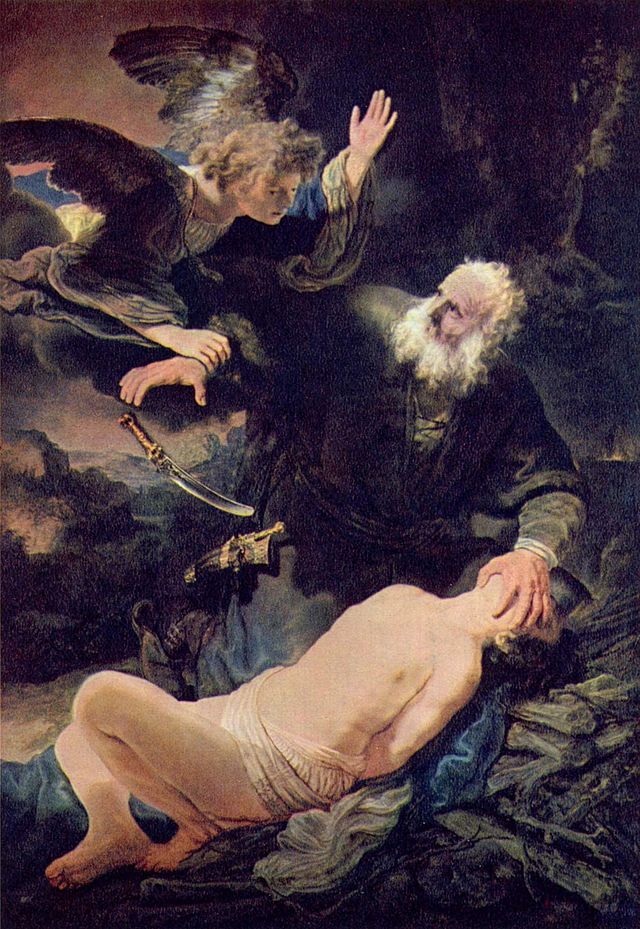
Sacrifice of Isaac by Rembrandt (1635)

In the atrium, we have walked (figuratively, anyway) with Abram from his home in Ur to "a land I will show you" and have seen Abraham's incredible trust and faith in the promise of this voice: to give him a land and descendants as numerous as the stars in the sky who will bless ALL nations.  Abraham was already 75 years old when he received this promise.

Fast forward 25 years.  Now the promise is seen with Abraham's own eyes: a SON.  Abraham holds the promise in his arms.  It kind of reminds me of Simon, in the Presentation in the Temple, who holds the Christ Child in his arms and says in effect, "Now you may let your servant go in peace! I've seen the promise!"

But Abraham's faith, made strong through 25 years of hope realized, is put to the test. 
This promise... this EVERYTHING of Abraham's... God asks him to offer as a sacrifice.  

It is striking and maybe shocking to us that the same Abraham who intercedes so beautifully for the Lord not to destroy the cities of Sodom and Gomorrah would not intercede for his son! It's almost like Abraham was expecting this, and indeed, if we look at the history of the peoples surrounding him, sacrifice of the first-born son was indeed a common practice.  Do you give your god the sickly and weak animal? Do you offer your leftovers to him? No.  The idea that led to this practice was that to prove your love for your god, you must offer your best--your everything.

But Abraham was not like the other people of his time, and the God who revealed Himself to Abraham was not just another god among gods.  He is the One, True God: the God of Life. 

Abraham's offering was total obedience and trust to this God of Life.  He trusted in a God who would not lie.  Isaac was the son promised, the beginning of an explosion of blessings through Abraham's descendants.  The author of Hebrews saw in Abraham's offering a New Testament faith: 

"By faith Abraham, when put to the test, offered up Isaac, and he who had received the promises was ready to offer his only son, of whom it was said, 'Through Isaac descendants shall bear your name.' He reasoned that God was able to raise even from the dead, and he received Isaac back as a symbol." Hebrews 11:17-19  Abraham obeyed God because he trusted in His promise.


As incredible as Father Abraham's faith is in this story, I hope you don't miss how God totally flips the sacrifice on its head.  For so much of human history, we see human beings wishing to prove their love and devotion to their god or gods.  They gave their best for the love of their god.  Yet, the One, True God says, "Do not do the least thing to him... I know now how devoted you are..." and provides his own Lamb for the holocaust.  In offering His only begotten Son,  the Father in Heaven reveals the unfathomable reality that He offers His Best for love of us.

"For God so loved the world that he gave his only Son, so that everyone who believes in him might not perish but might have eternal life." John 3:16

Thursday, December 25, 2014

Yes, Virginia, There Really is a Saint Nicholas

Over a hundred years ago, the New York Sun printed a letter to the editor from an 8 year old girl (Virginia) who wanted to know if there was really a Santa Claus. The famous reply is the most often reprinted editorial in the English language. It's actually a very interesting reply, and goes to the heart of believing in that which we cannot see, and how some of the most real things in life are not tangible at all.

Despite the beauty of Frank Church's famous response, when you think about it, it's not exactly what Santa Claus or Christmas is about. Christmas is not the feast in which we celebrate what we can't see, but that which we can! We celebrate the invisible made visible, Love made incarnate, God made man. Even this tradition of Santa Claus is born from tangible, real actions of generosity and charity that Nikolas of Myra (who was actually a bishop!) made anonymously and famously to those in need.

As one story goes, Bishop Nikolas (later known to us as Saint Nicholas), knew of an unfortunate man who owed a debt so large that he was facing the terrible necessity of selling his daughters into slavery. In the night, Bishop Nikolas snuck in and placed the needed amount of gold coins in their stockings as they hung to dry. How else was this man's radical charity inspired but by the profound humility and complete sacrifice of the Child who was born in Bethlehem this day.

Mr. Church noted that Santa Claus exists "as certainly as love and generosity and devotion exist" and that without this "there would be no child-like faith... no poetry, no romance to make tolerable this existence." He is right again, and this really is the reason we must continue to lift up for our children and for ourselves revolutionary examples of love and generosity and devotion.

Because, my friends, there really was a Christ Child born in Bethlehem over 2000 years ago, there really is a Saint Theresa of Calcutta, a St. Francis of Assisi, a St. Clare, and yes, Virginia, there really is a St. Nicholas.

Merry Christmas!
Mandie DeVries
Director of Religious Education